ABOUT US
ZEG Berlin
The Berlin Center for Epidemiology and Health Research
Do Good
ZEG Berlin is a leading institute in pharmacoepidemiology and real-world evidence (RWE) research, with a longstanding dedication to advancing women’s health and hormonal medicine.
With patients at the heart of everything we do, we are dedicated to the early detection and rigorous evaluation of drug safety risks – with a special focus on hormonal treatments, reproductive health, and therapies that affect women throughout their lives. Our research safeguards health and guides responsible medical practice worldwide.
As a full-service research organization, our core mission is to generate high-quality, actionable evidence. We provide comprehensive solutions for post-authorization and clinical studies, covering every step of the process: from study design and implementation to analysis, publication, and regulatory submission
Our legacy
From pioneering the EURAS-INAS study design in the late 1990s to launching Evin Hub in 2024, ZEG Berlin has consistently set benchmarks in pharmacoepidemiology and RWE innovation.
At ZEG Berlin, we are committed to delivering meaningful, reliable, and high-quality evidence with scientific excellence at every stage of our work. By fostering transparency, accountability, and unwavering dedication, we support better health decisions that improve patient outcomes.
Global reach
Our global network enables studies across Europe, the Americas, Asia-Pacific, and the Middle East.
Learn more about what we stand for, our team and company milestones.
What we stand for
ZEG Berlin GEvP
We generate and deliver following thoughtful, consistent rules of Good Evidence Practice (GEvP).
Ethical rules
We believe in short ethical rules.
Quality Principles
We believe in thoroughly sifted and documented procedures and quality principles as fundament of our work at ZEG Berlin.
ENCePP and EMA
We ensure regulatory alignment & methodological rigor (ENCePP/EU methodologial standards) as founding member of ENCePP.
EURAS-INAS study design and active surveillance
We invented new study methodologies, e.g. EURAS/INAS design, based on decades of experience on active surveillance with direct-to-patient contact.
Rating scales
We filled identified gaps through creativity by developing proprietary tools, such as patient-reported outcome (PRO) scales named AMS, MRS, QSF and SHE.
ZEG Berlin GEvP
What do we need it for?
In order to achieve lasting validity and scientific and regulatory acceptance, the generation of evidence should be consistently accompanied from initiation of the research process to the delivery of research reports or publications.
Our pharmacoepidemiologic studies are governed on the one hand by internal controlled documents, such as Standard Operating Procedures and on the other hand by external guidelines, including the respective Good Practice Guidelines.
The term evidence may sometimes be misleading. In our understanding, evidence should be generated and delivered following a set of rules. Internally, we like to look at the whole process as a very comprehensive task, that should be ruled by our so-called Good Evidence Practice Guidelines:
- At the start of a project, the need for research and the concrete research question must be well-understood by all parties involved.
- Close interaction with the sponsor's crew should be sought as early as possible. This may include meeting in person, but video-meetings can support the process under most circumstances.
- When appropriate, other scientific and medically qualified persons should be consulted or even involved.
- The optimal methodology for answering the research question(s) should be discussed.
- For this purpose, cost and speed and practicability have to be evaluated, leading to a spectrum of options.
- To a limited extent, previous methodology used in this context should be critically evaluated.
- The agreed protocol as approved by the Ethics Committee(s) and, potentially, regulatory authorities must be strictly observed, i.e., questionnaires must mirror the stated intentions.
- If an Independent Scientific Advisory Board (ISAB) or a Safety Monitoring and Advisory Committee (SMAC) has already been established, their consent to their role should be assured, including their knowledge and understanding of the study protocol.
- Information on study process (e.g., participant accrual, including recruitment of recruiters) should be discussed regularly and passed on to Sponsors and ISAB / SMAC as specified in the planning process.
- Interim Reports shall be prepared by the operational study team and reviewed by the internal medical, statistical and methodological teams before distribution.
- The matrix for the interim reports, as well as the final study report or publication shall be prepared early on. It should undergo scrutiny by the study team (and possibly other scientists, e.g., at the sponsors) and adaptive rephrasing should be anticipated/practiced.
- A critical appraisal of the potential sources of distorting factors (bias, confounder, secular trend, changing diagnostic instruments, changing classifications) should be initiated early in order to be available for the section limitations in the reports.
- The conclusions must be formulated in a strictly scientific wording in order to avoid exaggerations which could undermine the credibility of the research efforts and the results.
What we believe in
Ethical rules
The fundamental rules of ethics, summarized as “Do good” and “Do not harm” are essential elements for our company and apply in all of ZEG Berlin’s activities. We share the universally accepted values of good research: Truth, Honesty, Transparency, Quality and exact Documentation.
The rights of patients, health care professionals, sponsors and contributing scientists are strictly observed, guaranteeing privacy and respect. The national and international laws and regulations are carefully evaluated, as well as the opinions of the involved ethics committees.
ZEG Berlin‘s work is directly related to the improvement of health care. The primary purpose of our research activities is to answer questions regarding the safety and efficacy of therapies using epidemiological methods. In many of our field studies information is obtained directly from the patients, thus avoiding loss of important facts.
Furthermore, the thorough description of disease states and their course over time, as well as the effects of lifestyle and/or prophylactic measures, are major goals of our registry studies. The comprehensive description of important factors and trend generates information that can guide strategies in research on health and disease.
Quality principles
At ZEG Berlin, we are committed to delivering meaningful, reliable, and high-quality evidence with scientific excellence at every stage of our work. By fostering transparency, accountability, and unwavering dedication, we support better health decisions that improve patient outcomes.
The quality of our work is defined by the following principles:
Evidence-Driven Expertise
ZEG Berlin is committed to advancing research in hormonal health, building on deep expertise and efficient organizational processes within a compliance-focused environment.
Patient Safety as a Priority
We never compromise on quality. Our work ensures that drug safety risks are accurately identified — preventing both potential harm to patients and unnecessary barriers to essential treatment.
Leadership and Quality Culture
Quality stems from strong leadership and a culture of excellence that is actively embraced by our employees, customers, and partners alike.
Data Integrity as a Foundation
Reliable results depend on trustworthy data. We view data integrity — supported by a risk-based approach — as the cornerstone of data quality.
Continuous Improvement
We are committed to continuous growth by proactively engaging in knowledge development and closely monitoring our practices to refine and enhance our expertise.

By living these principles, ZEG Berlin reaffirms its commitment to quality, continuous improvement, and customer satisfaction.
ENCePP and EMA
We are a listed partner centre of the scientific network of ENCePP, the European Network of Centres for Pharmacoepidemiology and Pharmacovigilance, which is coordinated by the European Medicines Agency (EMA).
We are dedicated to excellence in research by adhering to the ENCePP Guide on Methodological Standards and promoting scientific independence and transparency.
We register ourselves and studies in the HMA EMA Catalogues which replaced the former ENCePP EU PAS Register of Studies, a publicly accessible resource for the registration of pharmacoepidemiological and pharmacovigilance studies.
More information on ENCePP and the ENCePP Partners is available at encepp.europa.eu.

The rigorous code of conduct set by ENCePP is ZEG Berlin’s standard bearer
All studies by ZEG Berlin adhere to the code of conduct set by ENCePP. ENCePP’s aim is to strengthen monitoring of the benefit-risk balance of medicinal products in Europe. It achieves this by facilitating high quality, independent, post-authorization studies and developing and maintaining methodological standards and governance principles in research. ZEG Berlin was invited to be a founding partner of ENCePP. All of ZEG Berlin’s eligible studies have been awarded the ENCePP seal.
EURAS/INAS study design and active surveillance
The ZEG Berlin European Active Surveillance/International Active Surveillance (EURAS/INAS) study design has been used extensively in Post-authorization safety studies (PASS) since 2000. By asking participants directly about their experiences with the study medication, we can gather data highly sensitive to the outcome of interest. All outcomes of interest are then validated by the treating physician to ensure that data is robust and specific to your needs. We are also able to include questions at both baseline and follow-up to elucidate important co-variables not easily sourced from electronic databases and registry data (e.g. mood, pain, and breastfeeding).
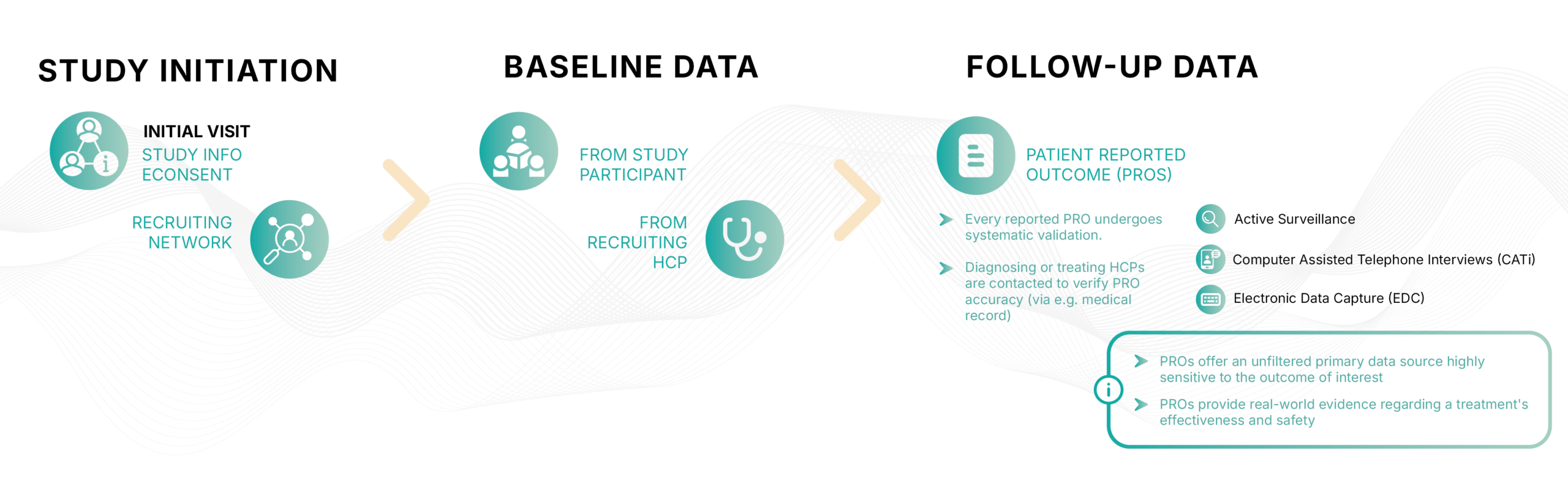
The EURAS/INAS study design is internationally acknowledged as being scientifically and methodically robust and effective in risk assessment in the post-marketing environment.
Scott Monroe, Division Director of the FDA, came to the conclusion that: “The EURAS study could be considered a model study for future post-marketing studies”.
In the context of the assessment of Venous Thromboembolic (VTE) risk, comparing different combined oral contraceptives (COCs), the FDA has stated:
“The EURAS study is the most rigorously designed prospective cohort study published to date comparing the risk of VTE between different COCs.“
Curious about our team?
Our work speaks for itself
The History of ZEG Berlin
From Scientific Legacy to Global Impact
2024

Launch of Evin Hub: The Future of RWE
In collaboration with the WIG2 Institute (Leipzig), ZEG’s RWE team co-founds Evin Hub – a centralized platform for cutting-edge real-world evidence research.  integrates:
- Comprehensive access to RWD
- State-of-the-art analytics and flexible study designs
- Expert teams of analysts, physicians, economists, and project managers
This makes Evin Hub the ideal launchpad for next-generation pharmaceutical research.
Now part of the Oracle Health ecosystem, ZEG Berlin coordinates studies across Europe, the Americas, Asia-Pacific, and the Middle East.
2021
Embracing Real-World Evidence (RWE)
ZEG Berlin launches a dedicated division for RWE & Safety Data Analytics, combining decades of experience in primary data collection with access to advanced real-world data (RWD) sources.
2007
Founding member of ENCePP
The company becomes a founding member of ENCePP (European Network of Centres for Pharmacoepidemiology & Pharmacovigilance), aligning with the highest regulatory and methodological standards.
Since the early 2000s
Leadership in Pharmacoepidemiology
ZEG Berlin expands internationally, becoming a leader in the early detection and evaluation of drug safety risks.
Key expertise areas include Epidemiology, Health Economics and Outcomes Research (HEOR), and Safety Analytics.
Late 1990s
Development of the EURAS-INAS study design
The EURAS-INAS study design was developed in response to the “Third Generation Pill Crisis”. The prospective patient-reported outcomes cohort methodology was able to accurately assess the real-use risk of very rare adverse outcomes in a population of healthy individuals. The EURAS-OC study was critical in resolving safety concerns regarding combined oral contraceptives. The study design has been used effectively in numerous Post Authorization Safety Studies (PASS) and risk management studies since.
1990
Founding of ZEG Berlin
In the wake of German reunification, Boethig and Heinemann establish Zentrum für Epidemiologie und Gesundheitsforschung (ZEG Berlin), evolving from their GDR-based department to an independent private research center. ZEG Berlin initially continues public health research projects from the Academy, then pivots toward industry collaboration and large-scale post-market safety studies.
1970s–1980s
International Collaboration & Methodological Innovation
As leading members of the GDR Academy of Science, Professors Siegfried Boethig and Lothar A. J. Heinemann contribute to major global studies such as MONICA, WHO OC, WHO Children, and INTERSALT.
Their department serves as the German WHO Reference Centre for non-communicable diseases.
Boethig is appointed Head of the Cardiovascular Disease Unit at WHO Geneva.
Together, they develop key standards for pharmacoepidemiological research, in parallel with institutions like Boston University and McGill University.
1960s
Early Beginnings in Berlin

Professors Siegfried Boethig and Lothar A. J. Heinemann begin their careers at the epidemiological study center of Humboldt University (Charité Hospital), focusing on cardiovascular health through cross-sectional population studies.